
If a key partner or technical lead in your company died or became totally disabled tomorrow, what would happen to the business? For many Malaysian private limited companies (Sdn Bhd) and limited liability partnerships (PLT), losing one person can hit cash flow, bank facilities and share ownership at the same time. Keyman insurance in Malaysia is one way to prepare for that. The company holds a policy on the person, and the payout gives the surviving owners time to stabilise the business.
This guide covers how these policies work, how LHDN treats them, and a simple checklist to set one up. It builds on our overview, Key Person Insurance: The Coverage Owners Skip.
What Is Keyman Insurance Malaysia and Why SMEs Need It
Keyman insurance is life, critical illness or disability cover that a company takes out on an important contributor. This is usually a founder, the person who brings in most of the revenue, or a director who has signed a personal guarantee for the company’s bank facilities.
Losing that person creates three problems:
- Operations stall. Replacing specialised skills takes time and money, and projects and client relationships can suffer in the meantime.
- Banks may review the facilities. Malaysian banks often ask directors to sign personal guarantees for working capital and term loans. If a guarantor passes away, the bank may review or freeze the facility unless there is enough cover or collateral.
- Shares go to the estate. Under the Companies Act 2016, a deceased director’s shares pass to their legal estate. If the surviving partners cannot afford to buy those shares, heirs with no business experience may end up co-owning the company.
A suitable policy gives the company cash quickly, so it does not have to sell assets or borrow in a hurry.
How LHDN Treats Keyman Insurance Premiums and Payouts
The Inland Revenue Board (LHDN) sets out the tax treatment in a public ruling (verify current: the ruling number and wording on hasil.gov.my before relying on this section). Not every premium an Sdn Bhd pays is deductible. It depends on the type of policy and its purpose.
| Policy type / purpose | Premium deductible? | Claim proceeds |
|---|---|---|
| Term life and personal accident (protects profits) | Generally yes, as a business expense | Taxable income in the year received |
| Whole life and investment-linked (builds cash value) | No (treated as a capital asset) | Generally a non-taxable capital receipt |
| Loan protection and buy-sell funding | No | Generally a non-taxable capital receipt |
For pure term cover taken to protect operating profit, the premium is generally an allowable deduction. Because the premium was deducted, the claim proceeds are generally taxed as company income (verify current: SME corporate tax rate of 15% on the first RM150,000 of chargeable income and 24% on the balance).
For policies with a savings or investment part, LHDN treats the policy as a capital asset. The premium is not deductible, but the death or disability payout is generally not taxed. The same applies to cover bought to back a bank loan or fund a partner buy-sell agreement.
Don’t choose a policy only for the tax deduction. A large tax-free payout can be worth more to the business than a small yearly deduction. Check your own case with your accountant.
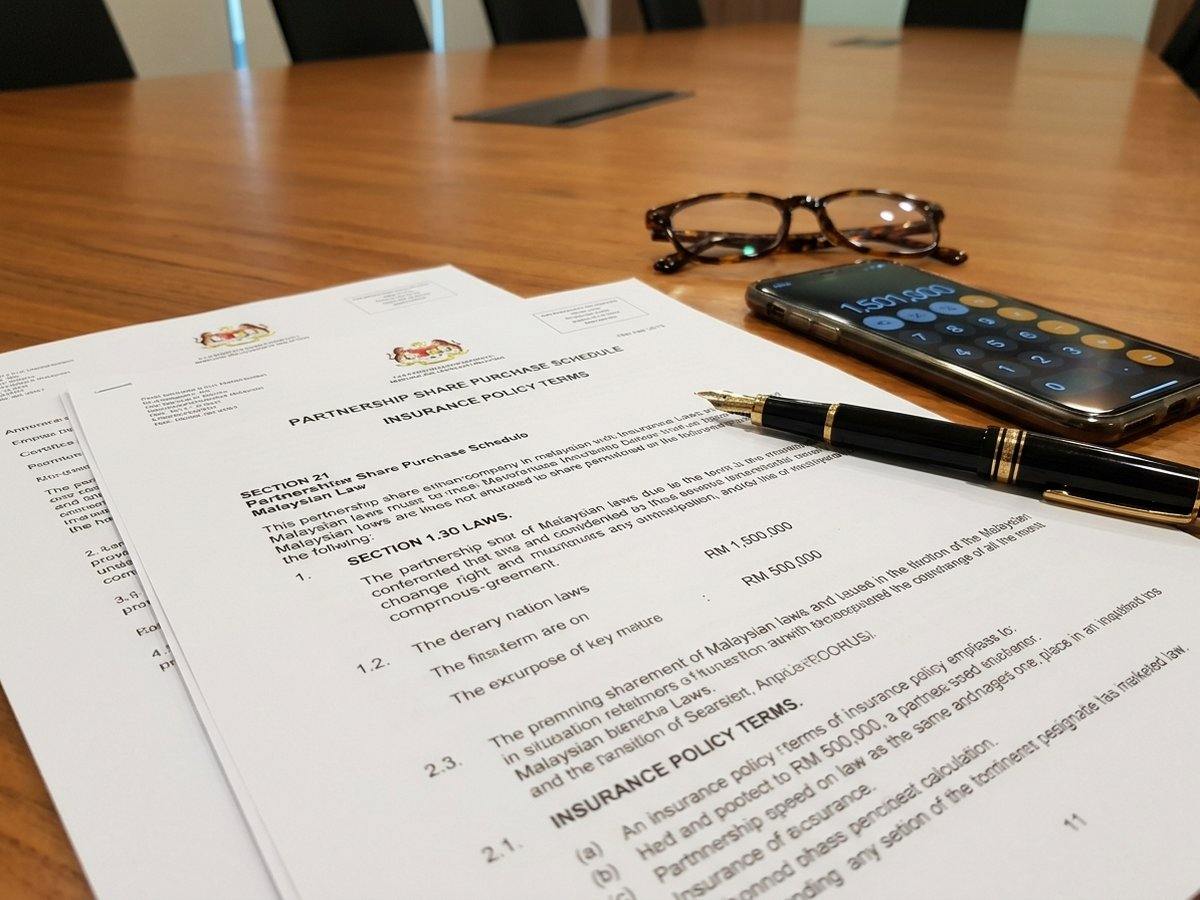
Structuring a Buy-Sell Agreement with Keyman Coverage
For companies with co-founders, keyman cover works best together with a buy-sell agreement. Without a binding contract, a payout to the company does not force the deceased partner’s heirs to sell their shares.
Take two partners who each own 50% of an Sdn Bhd. If Partner A dies without a will, his shares go to his estate under the Distribution Act 1958 (or Islamic inheritance rules for Muslim owners). Partner B could end up sharing ownership with family members who want cash, not a long-term business.
Companies usually solve this in one of two ways:
- Cross-purchase: each partner buys a policy on the other. When a claim happens, the surviving partner uses the payout to buy the shares from the estate at a price set by an agreed formula.
- Trustee-held: a licensed trust company holds the policies and the share transfer documents. When a valid claim is made, the trustee pays the family and transfers the shares to the surviving owner.
A trust can also help avoid delays in probate, but talk to a lawyer about how it should be set up.
Step-by-Step Checklist to Set Up Keyman Coverage
- Work out the value. Estimate 3 to 5 years of the person’s contribution to profit, the cost of hiring and training a replacement, and the total bank loans that carry their personal guarantee.
- Pass a board resolution. The directors approve the purchase, state the business reason, and name the insured person.
- Draft the buy-sell agreement. A corporate lawyer sets out the trigger events (death, total permanent disability, critical illness), how the shares are valued, and the timeline.
- Complete medical underwriting. The insured person must answer health questions fully and honestly, or a claim can be disputed.
- Review every year. As the business grows, review its valuation during your annual audit and adjust the cover.
Frequently Asked Questions About Keyman Insurance
Can a sole proprietorship buy keyman insurance in Malaysia?
Generally no. A sole proprietorship is not a separate legal entity from its owner, so the business cannot own a policy on the proprietor. The owner can buy personal life and disability cover to settle business debts. A Sdn Bhd or PLT can own a keyman policy.
What happens if the key person leaves?
The company usually has three options: surrender the policy to get back any cash value, transfer it to the person (who then pays the premiums), or stop paying if it is pure term cover.
Is the payout subject to SST?
Life insurance and family takaful are generally exempt from service tax. General commercial insurance may attract service tax (verify current: the rate and scope on the Royal Malaysian Customs Department website). Claim proceeds themselves are not a taxable service.
This is general information, not tax or legal advice. Please check the details with your accountant and lawyer.
Official sources: Inland Revenue Board of Malaysia (hasil.gov.my), Bank Negara Malaysia (bnm.gov.my), Companies Commission of Malaysia (ssm.com.my).