
Winning an order from a large company, a government-linked company or a retail chain is good news. But those customers often pay after 60, 90 or even 120 days. In the meantime you still have to pay suppliers, staff and taxes. Invoice financing in Malaysia is one way to release some of that cash earlier. This guide explains how it works, what it costs and where it can go wrong. For other options, see our overview of SME financing in Malaysia.
The cash flow gap
Many small businesses struggle because of timing, not because of a lack of orders. You pay for materials, transport and salaries up front, and the customer pays much later. That causes three common problems:
- You can’t take the next order. Cash is tied up in unpaid invoices, so there is little left to buy materials for a new purchase order.
- Bank limits run out. Overdrafts and term loans usually need property or other collateral and a director’s guarantee. Young or asset-light companies can reach their limit quickly.
- Your own suppliers wait. When customers pay late, you pay your suppliers late, and you can lose early-payment discounts.
How invoice financing works
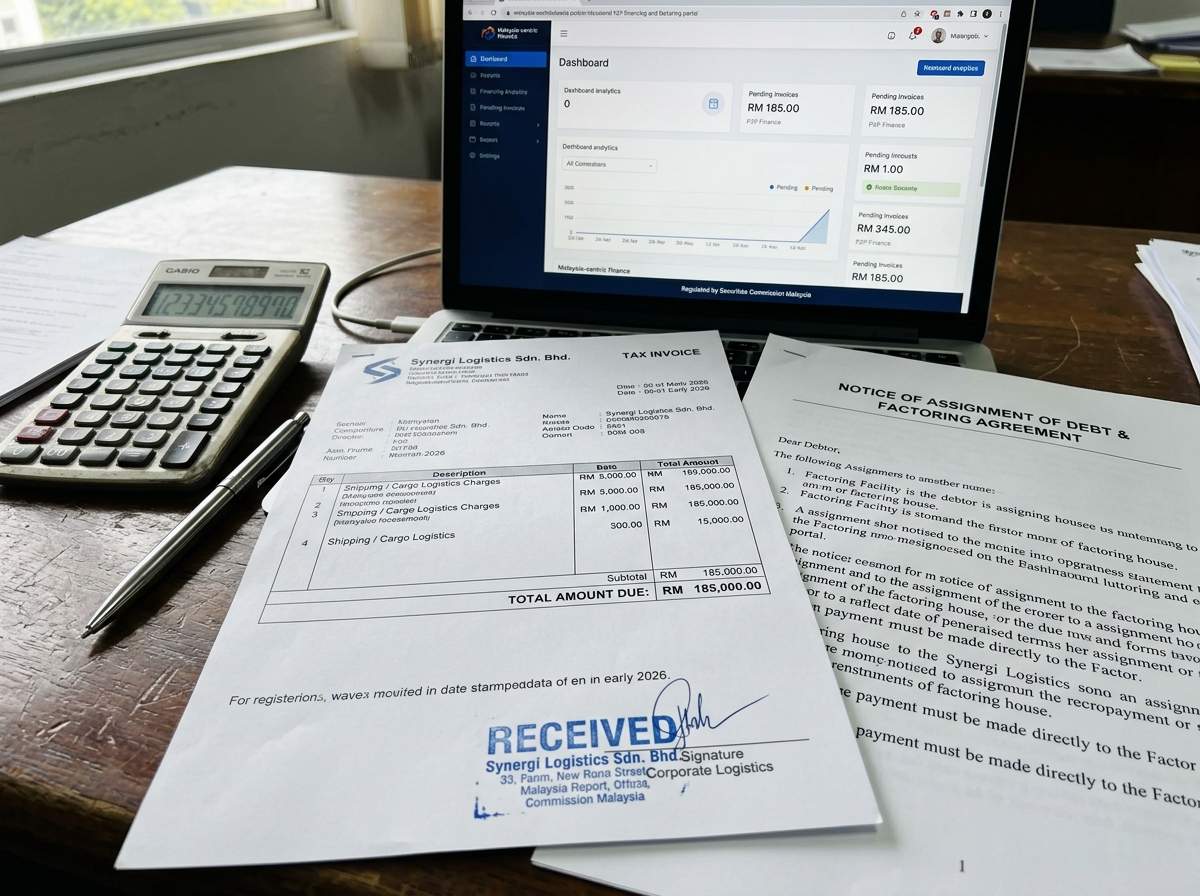
Invoice financing, also called factoring or invoice discounting, is a short-term facility backed by your unpaid invoices. The financier looks mainly at how reliable your customer is, not at your fixed assets. The usual steps are:
- Deliver and invoice. You supply the goods or service and issue a tax invoice with a signed delivery order or acceptance document.
- Submit and verify. You send the invoice and proof of delivery to the financier, who checks the customer and offers an advance. This is usually a percentage of the invoice value, and it differs between providers.
- Receive the advance. The money is paid into your business bank account. How fast depends on the provider.
- Customer pays. When the customer pays on the due date, the financier takes back the advance plus its fees and pays you the balance.
Disclosed factoring and confidential discounting
Disclosed factoring
The customer is told the invoice has been assigned to the financier and is asked to pay into a collection account. Because the financier controls repayment, terms can be better.
Confidential invoice discounting
The customer is not told, and you keep collecting the payment yourself. This keeps the customer relationship unchanged, but financiers usually ask for a stronger business before they agree.
Invoice financing compared with a bank overdraft
Rates, limits and approval times vary by provider, so ask for written quotes before you compare.
| Point | Invoice financing | Bank overdraft |
|---|---|---|
| Security | Your invoices and your customer’s credit standing | Usually property, fixed deposits or other collateral |
| Limit | Tends to grow with your sales | A fixed limit that needs a review to increase |
| Speed to set up | Often faster | Often slower, because of bank checks |
| Cost | A fee for the period the invoice is financed | Interest on the amount you draw |
Checklist before you apply
- Review your receivables. Identify invoices owed by reliable customers with a clear payment history.
- Tidy your proof of delivery. Delivery orders and acceptance documents should be signed, dated and free of disputes.
- Check your contracts. Make sure your customer agreements do not forbid assigning invoices.
- Choose a regulated provider. Use a bank, or a peer-to-peer operator registered with the Securities Commission Malaysia.
Costs and risks to weigh
- Fees reduce your margin. If your margin is thin, work out whether it can absorb the financing cost before you sign.
- Recourse. Many facilities are with recourse, which means that if your customer does not pay, you must repay the financier.
- Customer cooperation. Some customers are slow to confirm an assignment.
Frequently asked questions
Can I finance invoices issued to individual customers?
Usually not. Invoice financing generally covers sales to businesses or government bodies, because sales to many individual customers are harder to verify and collect.
What is the difference between recourse and non-recourse?
With recourse, you carry the risk if the customer does not pay. With non-recourse, the financier carries it, but this usually costs more and has stricter conditions.
Is there a Shariah-compliant option?
Yes. Some banks and platforms offer Islamic invoice financing based on contracts such as Murabahah. Ask the provider which contract they use and who certified it.
This is general information, not financial or legal advice. Please compare written quotes and speak to a licensed adviser before you sign.
Sources
- Securities Commission Malaysia: rules for peer-to-peer financing operators (sc.com.my)
- Bank Negara Malaysia: information on financing facilities (bnm.gov.my)
- SME Corporation Malaysia: SME financing resources (smecorp.gov.my)